🌍 As the 4th International Conference on Financing for Development (FFD4) wrapped up on July 3rd, 2025, it became clear: the global financial system remains rigged against the world’s majority.
Despite urgent calls for structural reform, governments and institutions largely recycled tired rhetoric – doubling down on austerity, debt,and private finance while ignoring people and communities on the frontlines of crisis, as well as the planet.
🏛️ Financing for Whom? FFD4 Delivers Hollow Commitments as cuts and Inequality Soar
FFD4 was billed as a “once-in-a-generation opportunity” to fix the global financing system. Instead, rich countries blocked meaningful debt cancellation, refused to agree on new public financing for climate and development, and pushed “blended finance” schemes that funnel public money into corporate hands.
Powerful governments and institutions continued promoting austerity as the default “solution,” ignoring mounting evidence of its human cost. From Pakistan to Ghana, social spending cuts and wage freezes are pushing millions further into precarity.
The Compromiso de Sevilla outcome document reinforced this failed consensus. While it included references to “fiscal sustainability” and “responsible debt management,” it stopped short of endorsing any concrete debt cancellation mechanisms. Instead, it emphasised “domestic resource mobilisation” and “fiscal consolidation”- language repeatedly used to justify regressive taxes and public spending cuts. The declaration praised public-private partnerships and blended finance, despite abundant evidence that such approaches often deepen debt vulnerabilities and inequality.
This approach amounts to forcing countries to choose between paying creditors and protecting their people. Instead of cancelling illegitimate debts or taxing extreme wealth, governments are entrenching a cycle of austerity, inequality, and dependence. Without decisive action to overhaul the system, the crises will only deepen – robbing communities of their right to health, education, and a dignified future.
✊ Voices of Resistance: Building a Global Front Against Debt and Austerity
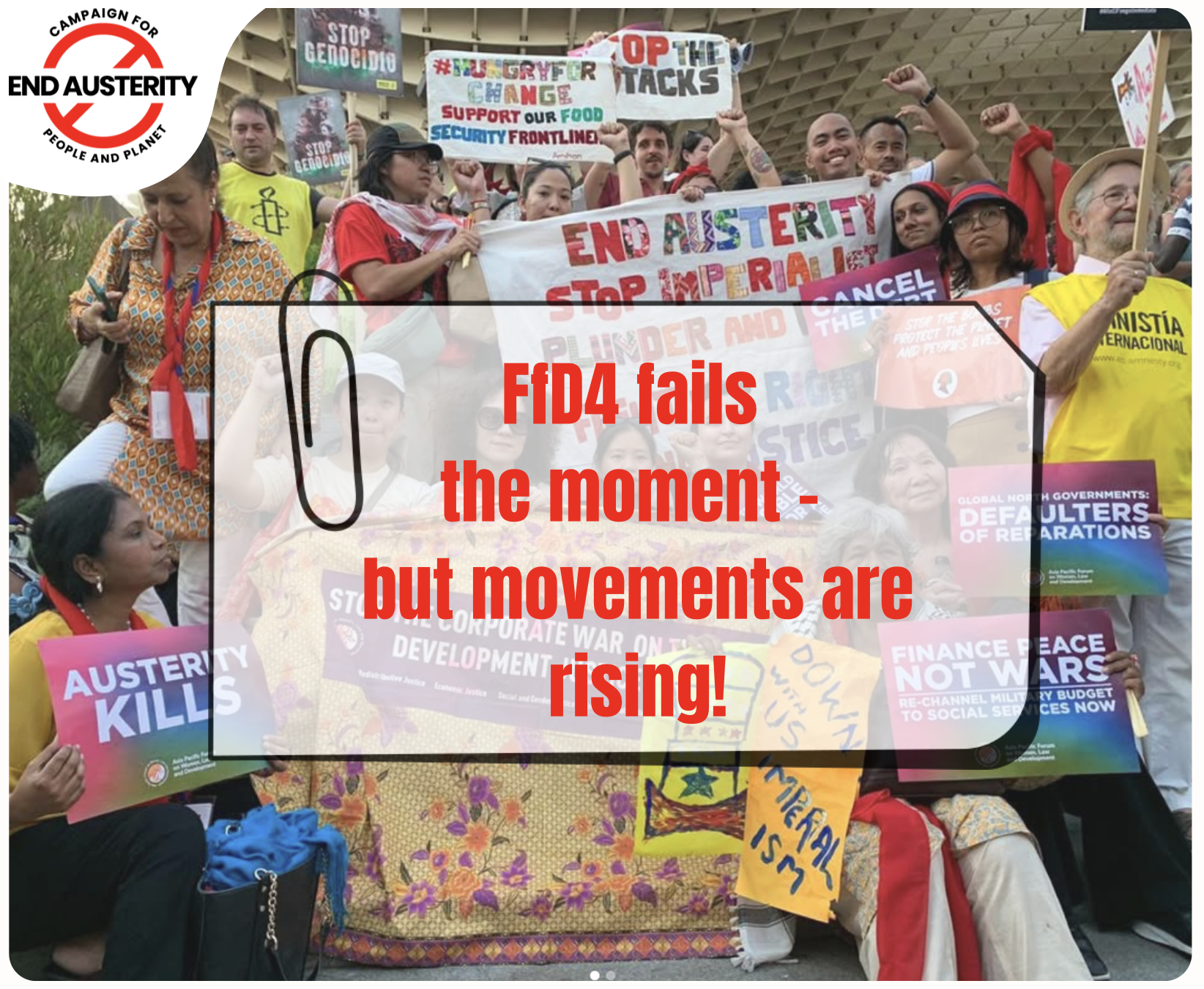
While diplomats drafted watered-down declarations inside the conference halls, our movements mobilized with clarity and urgency – demanding economic justice and real transformation.
Debt, Colonialism, and Militarism – Decolonial Territory
On June 30, activists including Emilia Reyes, Raouf Ben Mohamed, and Collins Liko exposed how debt and militarism entrench colonial power. The gathering called for decolonial alternatives and solidarity across regions.
Rights-Based Development Finance: A Post-Seville Agenda
At Fibes Sevilla, UN officials, tax justice campaigners, and human rights defenders demanded a financing system grounded in rights and transparency – not austerity.
From Austerity to Rights
On July 2, movement leaders challenged the IMF’s budget cuts, urging investments in health, education, and social protection as non-negotiable foundations for justice.
These events showed the power of collective action: if governments won’t change course, people’s movements will lead the way.
📚 Tools to Fight the Austerity Agenda
As governments and institutions cling to failed orthodoxies, movements are building bold alternatives grounded in justice and solidarity. Here’s what our allies are putting into the world:
🔸 Disrupting the Austere World: A Primer on Austerity, Neocolonialism, and Resistance (June 2025)
A timely primer unpacking how austerity is imposed as a neocolonial tool-and how movements worldwide are disrupting it.
🔸 Latin American Tax Justice Network – Tax Justice for the Human Right to Education in Latin America and the Caribbean (June 2025)
A vital resource linking tax justice to the right to education, showing how fair taxation can fund public goods and dismantle inequality.