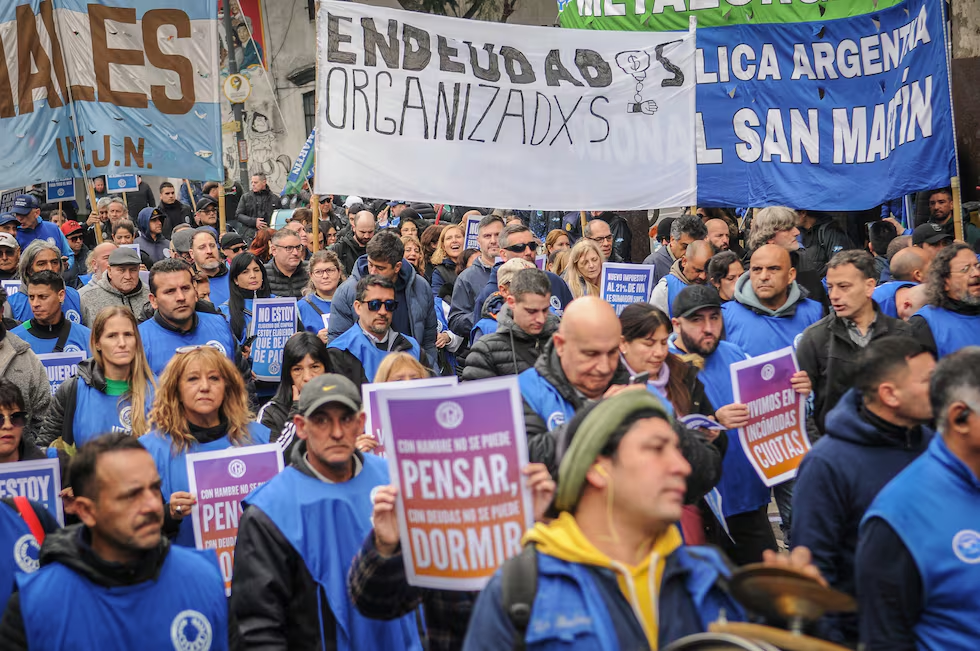
Thousands of people took to the streets in Buenos Aires on Thursday to demand relief measures as household indebtedness reached its highest level in 20 years under President Javier Milei. More than 5.8 million Argentines – around 12.5 percent of the population – are behind on loan payments, an unprecedented level since the country’s major 2001 crisis, according to Central Bank data quoted by the Buenos Aires Times.
There is an even larger number – for which no figures are available – linked to the underground economy: neighbourhood moneylenders who, according to social organisations, are often connected to drug trafficking or organised crime. “This petition calls on the Government to provide an immediate solution. They are responsible for this economic crisis, which is worsening and reaching critical levels for families,” said Cristian Jerónimo, general secretary of the CGT.
There is an emotion linked to debt: shame. This is particularly true of the middle class, which is unaccustomed to the ways brought about by libertarian ideologies. “I got into debt with online lending platforms because they tell you to pay in instalments, but then they bleed you dry with interest. I ended up asking my mum for money to pay off that debt; I’m ashamed to say it,” admitted Gabriel, a teacher with two children who rents his home and was in Plaza de Mayo yesterday. “I work all day, but I can’t make ends meet; it’s impossible,” he complained. “The government only responds to the concentrated economic interests. For us, everything is getting more expensive. With 30 per cent inflation, they’re charging 100 per cent interest – how can they be allowed to do that to their friends? It’s a scam,” he added.
That is one of the demands made by the trade union federations: that the Central Bank fulfil its role as regulator of the interest rates applicable to bank loans, financial apps and virtual wallets. According to a report by the Centre for Argentine Political Economy (CEPA), default rates on the latter two options reached 29.6 per cent, a figure that exceeded pre-pandemic levels. These levels are three times higher than those of traditional banks and mainly affect young people and lower-income groups, who take on debt to cover everyday expenses..
Meanwhile, from the Alvear Hotel, Milei was speaking at the Council of the Americas and stating that “unemployment has not risen, nor have wages fallen”, whilst in Plaza de Mayo the leaders of the CGT were submitting a petition to the Ministry of the Economy outlining a different scenario: “When a family can no longer afford to pay off a credit card or a loan, it stops spending. When a company cannot finance its working capital, it scales back its operations. And when consumption and production fall, employment also suffers.”
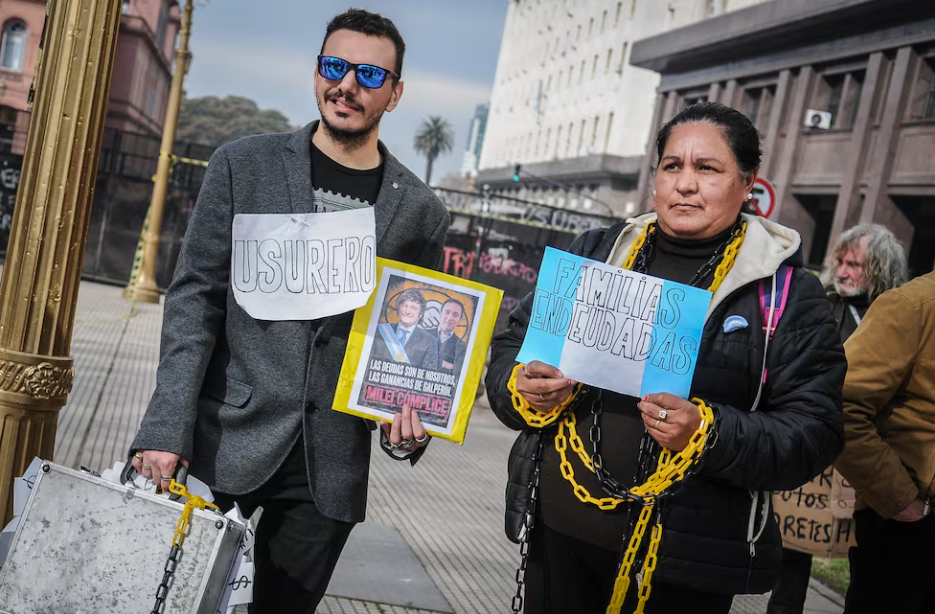
The protest was backed by the country’s main trade union confederations, the CGT and CTA, as well as left-wing parties. Demonstrators occupied part of Plaza de Mayo, next to the Economy Ministry, which was cordoned off with barriers and surrounded by a heavy police presence. Among the trade union flags were banners carrying messages against digital wallets, such as Mercado Pago, that operate as lenders.
The protesters are calling for state intervention to restructure or manage excessive household debt and regulate exorbitant interest rates charged outside the formal financial system, which borrowers turn to because they lack access to bank credit. In a recent interview, Milei said debt was “a matter between private parties” in which the state should not intervene. “Today we marched on the Economy Ministry against a model that is forcing Argentine families to take on debt to buy food, pay the rent and keep basic services running,” the CGT said after the march.