Speaking in Singapore, ahead of the IMF and World Bank annual meetings last October, Kristalina Georgieva said policymakers “can no longer rely on higher growth rates alone to solve fiscal problems”. The managing director of the IMF told governments to tighten their belts and central banks to take a “hawkish stance”, signalling a return to austerity as the energy shock from the Iran war, record public debt and a credit-fuelled AI investment boom weigh on the global economy.
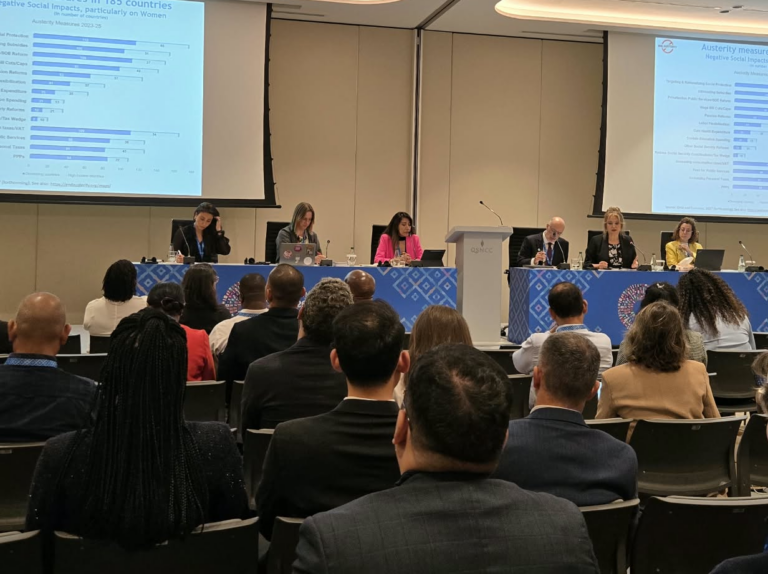
During a panel debate held in Bangkok as a side-event of the World Bank-IMF summit, these views of the IMF were challenged from different angles. The event confronted the views of researchers and human rights experts with those of Rodrigo Valdés, director of the Fiscal Affairs Department at the IMF. Isabel Ortiz, of Global Social Justice; Roos Saalbrink, of ActionAid International; Chiara Mariotti, from the UN Office of the High Commissioner for Human Rights; and Farah Al-Shami, of the the Arab Reform Initiative offered the evidence on the impacts of austerity policies in practice, while Valdés framed the problems of debt as issues of “intergenerational equity”.
Below is an edited transcript of the panel discussion. You can also see the video of the debate.
Patricia Miranda (Latindadd, moderator): My name is Patricia Miranda. I am the Global Advocacy Director at Latindadd, and I am very happy to be facilitating today’s conversation with a great panel. This event was co-organized by a collective of civil society organizations and networks with global, regional and national representation.
So, what was the motivation for organizing this panel? Just as a brief introduction: in her curtain raiser earlier this week, the IMF Managing Director said that fiscal policy is the place where all pressures meet. In a context of elevated yields, there are competing spending priorities, which unfortunately seem to include defense as well. The narrative that fiscal consolidation is the only way has demonstrated over decades that it is not fit for purpose. Developing countries may be forced to cut development expenditure regardless of their urgent needs, especially in a context of multiple crises. Belt-tightening is a short-term policy, at the expense of the people most exposed to vulnerabilities in developing countries.
What this panel is going to present today is global data and information showing how the costs of austerity are shifted to households, weakening public services and deepening social and gender inequalities.
I will introduce each of our speakers; we will then have their presentations, followed by a Q&A. I would like to welcome Isabel Ortiz, Director of Global Social Justice; Roos Saalbrink, Global Lead on Economic Justice and Public Services at ActionAid International; Chiara Mariotti, Human Rights Officer at the UN Office of the High Commissioner for Human Rights; Farah Al-Shami, Social Protection Program Director and Senior Fellow at the Arab Reform Initiative; and, last but not least, Rodrigo Valdés, Director of the Fiscal Affairs Department at the IMF.
So, without further ado, I would like to ask Isabel Ortiz to start. Isabel, can you share with us the new global dataset you have worked on, on fiscal consolidation measures in all countries? Please tell us how bad it is, and what the financing alternatives are.
Isabel Ortiz (Global Social Justice): I’m going to start with the global picture. This is an analysis we started while I was a director at UNICEF during the financial crisis, and that we kept updating in later years at the ILO, the International Labour Organization in Geneva, and now at Columbia University and Global Social Justice. What we do is look at fiscal trends from 2008 onwards, using IMF data.

This map shows where austerity is today. Virtually the whole world is affected: 5.7 billion people live in countries that are doing austerity. That is 71% of the world population. This is a topic that matters to the majority of the world.
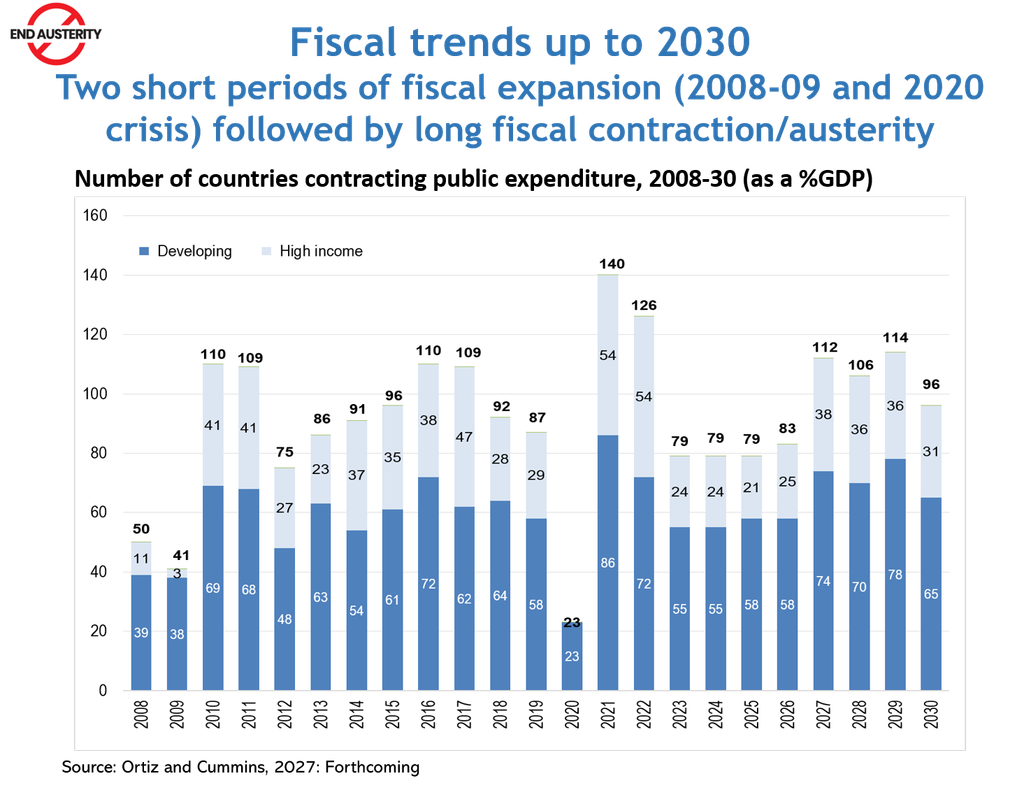
Looking at the trends, the bars show the number of countries contracting public spending each year. The first year is 2008, the financial crisis, and the last is 2030, which is as far as the IMF fiscal projections reach. You can see that in all these years there have been major expenditure cuts; the majority of countries have been contracting public spending — developing countries in the darker colour, higher-income economies in the lighter colour. They are all cutting expenditures, with the only exceptions of 2008, 2009 and 2020, the pandemic year, when there were almost no cuts, and rightly so as governments needed to support populations.
But the problem is that we are now in the middle of what is called a polycrisis. We have a cost-of-living and food crisis, high fuel prices, a debt crisis, a climate crisis, a job crisis, and others, in a context of war and militarization. These are all man-made crises, and arguments for actually expanding spending more on people and on ways to solve these crises — particularly development spending and social protection spending — are extremely strong. This is not the time to adjust expenditures.
And how are these cuts made? For that, we looked at hundreds of IMF country reports and the policy debates included in them. And this is the new data tells us: in the last two years, in the majority of countries, the most common fiscal consolidation measure was targeting and rationalizing social protection. This is an absolute paradox, because it is described as improving social protection, but there is no improvement: very often broad benefits — for families, for persons with disabilities, pensions — are cut and replaced by a very small safety net targeted to a percentage of the poor. Replacing a comprehensive, or more or less comprehensive, social protection system with a small safety net actually undermines human rights, the right to social security, and is detrimental to the majority of the population.

The second most common measure, well known to many people here, is the elimination of subsidies, including food, agriculture and fuel subsidies. There is a big debate on that.
The third most common measure is the privatization of public services. This is often presented as “reform of state-owned enterprises”, which is a complicated name for civil society and citizens, but it actually means public transport, energy, water supply, sanitation and other public services, at the national or local level. Privatizing these public services obviously have very negative social impacts, as they generally end in higher prices, lower quality services and lay-offs. Sometimes the reforms are not privatization but commercialization of those services, which leaves them ready to be privatized later on.
Then there are wage bill cuts and caps, which means cutting the number or the salaries of civil servants — generally, the largest group of civil servants in a country tends to be teachers, health staff and local civil servants, all doing very important tasks for people. I won’t develop that, because my colleague Roos is going to present it.
Then come pension reforms with a cost-effectiveness lens, which often means that pensions benefits are reduced, in a situation where old-age poverty is growing in many countries. Having worked at the ILO, I know that any pension reform has to balance sustainability and equity. It is a very delicate matter that needs to be handled through national social dialogue, not just cuts to benefits at the Ministry of Finance.
Then come labour flexibilization reforms, cuts to health spending even after the pandemic, containment of education spending, and other social security reforms. And last but not least, reducing employers’ social security contributions, which actually makes social security unsustainable. This is presented as a way to promote growth, but these contributions are the deferred wages of workers, and they need to be preserved.
On the revenue side, we have increases in consumption taxes, or VAT. This is a highly regressive measure, because the poor pay the same as the wealthy. Then fees for public services and increases in personal income taxes. As we see, taxation today mostly falls on the middle and working classes; the wealthy really pay very little. This needs to change. And then promotion of PPPs for public services, which leads to high user fees for people and high contingent liabilities for governments.
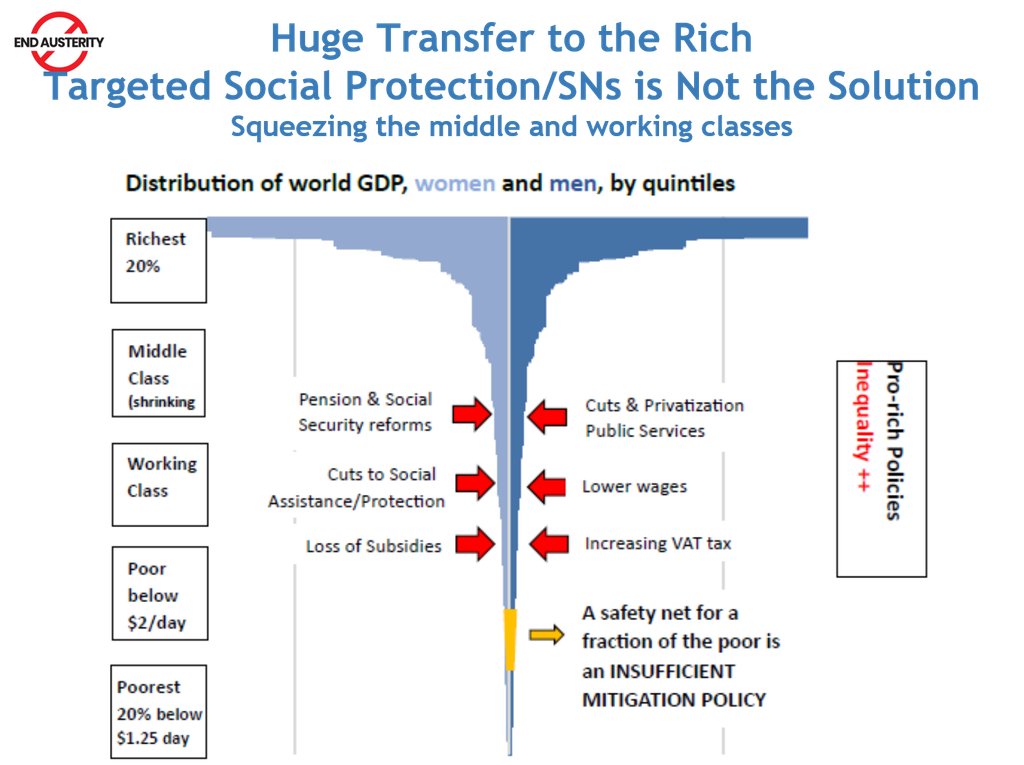
So, if this is the distribution of income, with the richest at the top and the poorest at the bottom, all these measures are actually squeezing the middle and working classes. Whether we look at pension and social security reforms, privatization or cuts to public services, they squeeze the middle and working classes, who are already paying a lot of tax. And then there is myth that providing a small safety net targeting a percentage of the poorest is “compensation”, which it is not, it is an insufficient compensation measure. If we had to compensate, we would have to think of other ways that would include the working and middle classes.
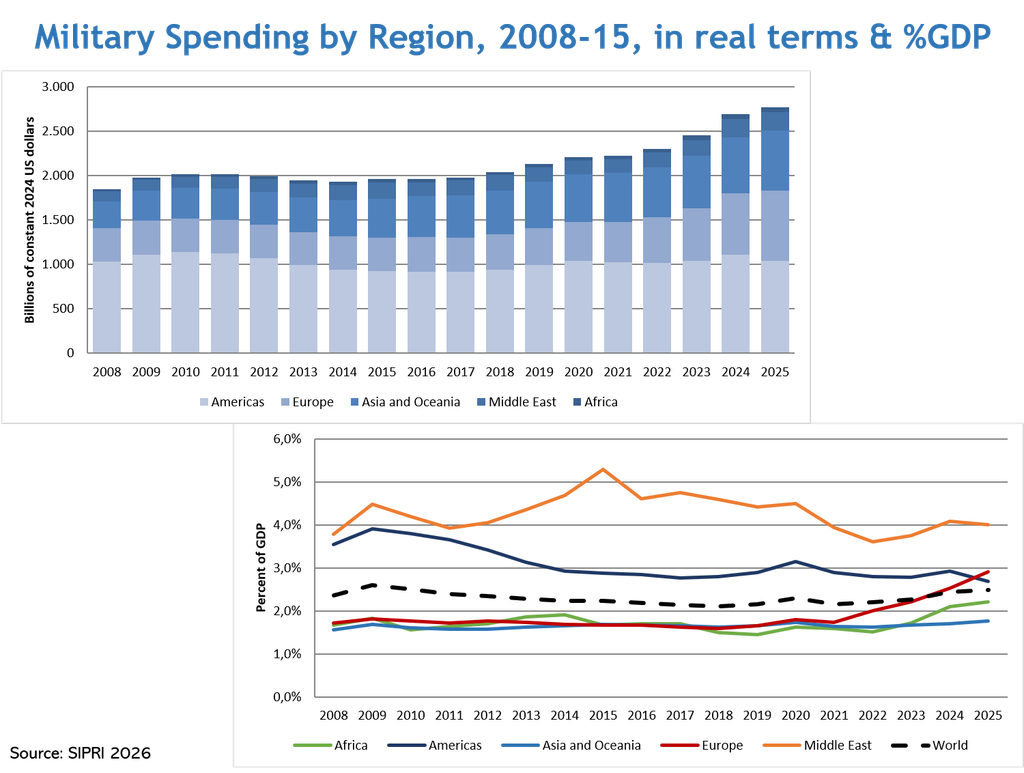
On top of that, military spending is growing. Looking at 2016 to 2025, there has been a 41% increase in the last ten years, led by Europe, Asia, Africa and the Middle East.
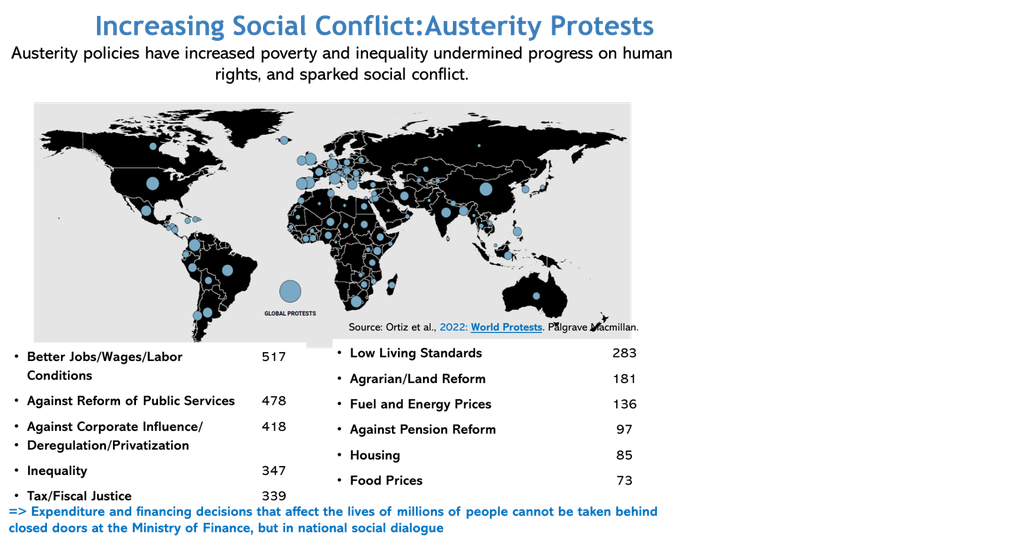
All these measures together are contributing to social instability and social conflict. We looked at the number of protests — this is another study we did, published with Palgrave Macmillan and Columbia University. Protests against austerity cuts are spreading all over the world, and the most common are for better jobs, wages and labour conditions, against the reform of public services, against corporate influence, for tax and fiscal justice, and others.
What is most important for us to discuss here today is that all this human suffering is unnecessary, because there are financing options available in all countries, even the poorest countries. There are at least ten options, all of them supported by the international financial institutions as well as by the UN, that would make it possible to redress fiscal consolidation and to make progress towards human rights and the development goals.
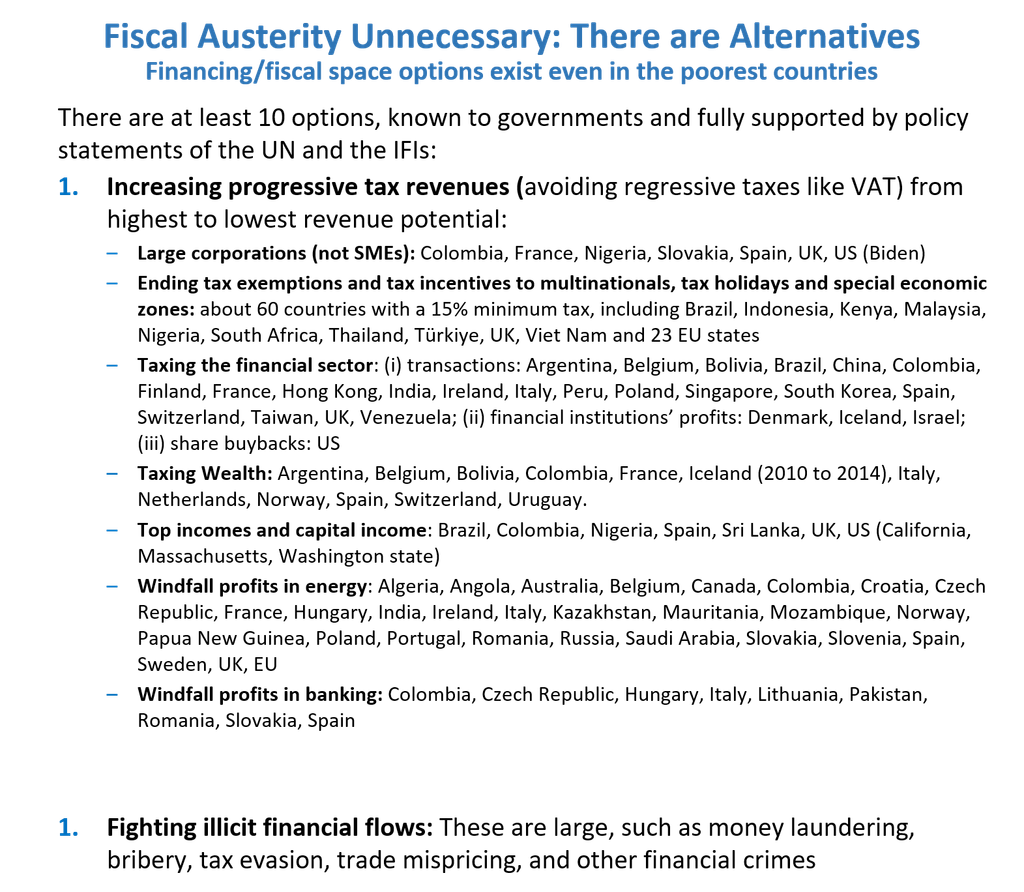
The first option is to increase progressive tax revenues. That means not to rely on consumption taxes, and not squeezing the working and middle classes with income taxes, but shifting taxation towards the top. Tax large corporations, not SMEs. End corporate tax exemptions and incentives — tax holidays and so on — as a large number of countries have done. Tax the financial sector, which very often is not taxed or is lightly taxed; we have a long list of countries doing so. Tax wealth: this is happening in a number of countries, sometimes only for a few years because conservative governments tend to remove it, but it is happening, in countries like Belgium, Bolivia, Colombia, France, Iceland, Italy, the Netherlands, Norway and Spain. Tax top incomes and capital income, which a number of countries also do. And, more interestingly, windfall profits in energy: there is a long list of countries implementing them — without boring you, from Algeria, Angola, Australia, Belgium, Canada, Colombia, Croatia, and so on. It is possible. It is not a dream; it is not unfeasible; it is happening in many countries. The list of ways to increase progressive tax revenues continues — for example, taxing large digital multinationals (not the little online creator but large firms like Amazon, Uber and so forth).

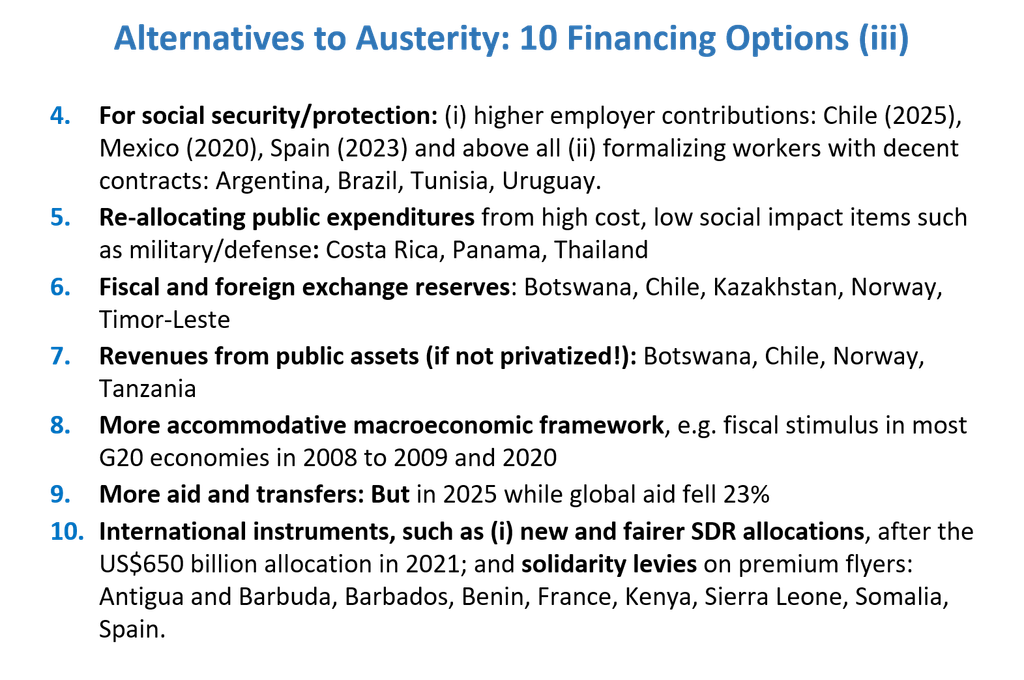
And that was only the first option, there are 9 more options. The second is to fight illicit financial flows, which are illegal and need to be fought. Then debt restructuring and debt elimination, with more than 60 successful country cases. Expanding social security coverage by formalizing workers with decent contracts, and ensuring that employers pay adequate social security contribitions. Reallocating public spending, particularly away from defence, like Costa Rica and Thailand did to expand universal health. And other measures, including some international ones.
Above all, to end: these decisions affect the lives of millions of people, and they cannot be taken behind closed doors. They must be taken through national open social dialogue — with trade unions, civil society organizations, obviously government and employers, all the major social actors — and they must be taken to parliament and decided openly, debating who wins and who loses. Ministries of Finance need to provide information on the distributional impacts and on the fiscal space options that countries have. All countries are different, but fiscal space options exist in all countries, even in the poorest countries. If we continue taking these decisions behind closed doors, it is bad governance, it is undemocratic, and it is against human rights. It’s time to move towards good governance and ensure that, through national open dialogues and parliamentary debates, each country takes optimal solutions for all citizens, not just the elites, and decides its own future collectively. Thank you very much.
Patricia Miranda: Thank you, Isabel. We can think of the people who are suffering these impacts, and also of the decision-makers in whose hands lies the implementation of these ten options.
I would now like to move to Roos Saalbrink, from ActionAid. Roos, you have just released a report with very interesting and important findings on IMF advice in more than ten countries. What are the main findings? Is the IMF still cooking with the same recipes?
Roos Saalbrink (ActionAid International): Thank you, and good morning — or good afternoon to those joining from elsewhere. We worked on this together with many of the partners here in the room, so I’m speaking on behalf of everyone who worked on this research. I’m really excited that many colleagues who worked on it are in the room today, since it hasn’t been possible for many of them to travel to the IMF meetings in the US.
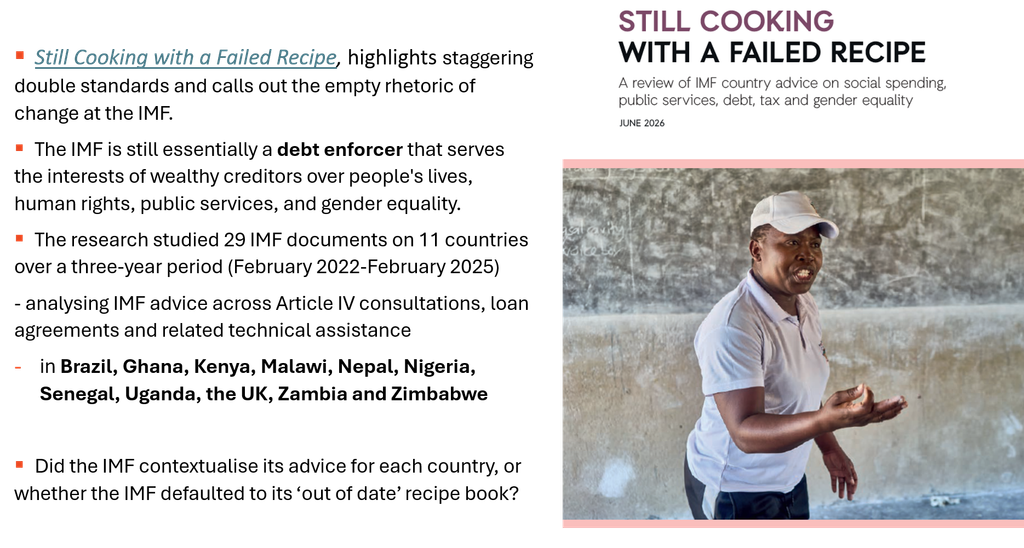
I want to start by saying that this research was not done to influence the IMF, but to help CSOs at national level understand what the IMF is advising in surveillance, loan documents and capacity development programmes, and to what extent the IMF is saying anything different on tax. We have heard from colleagues at the Fiscal Affairs Department that there is more progressive tax advice in capacity development, but not so much in loan programmes, because those are crisis situations. So we wanted to see what is actually happening on tax.
We reviewed 29 documents across 11 countries: Brazil, Ghana, Kenya, Malawi, Nepal, Nigeria, Senegal, Uganda, the UK, Zambia and Zimbabwe. I want to clarify that we reviewed the documents; we did not check which policies were implemented, which is something we have done in the past.
So, as Patricia asked, is the IMF still cooking with the same recipe? I’m going to focus on tax and gender, because Isabel has already spoken about social protection and public sector wage bills, and our findings there are very similar to what we found in the past. In essence, we found that the IMF is still enforcing debt repayment over the interests of people’s lives, human rights, public services and gender equality.
On tax, we can see a significant shift: there is a lot more on tax in the documents. I want to make clear that there is a distinction between what is in the text of the IMF documents and what is in the tables, and that distinction runs throughout.
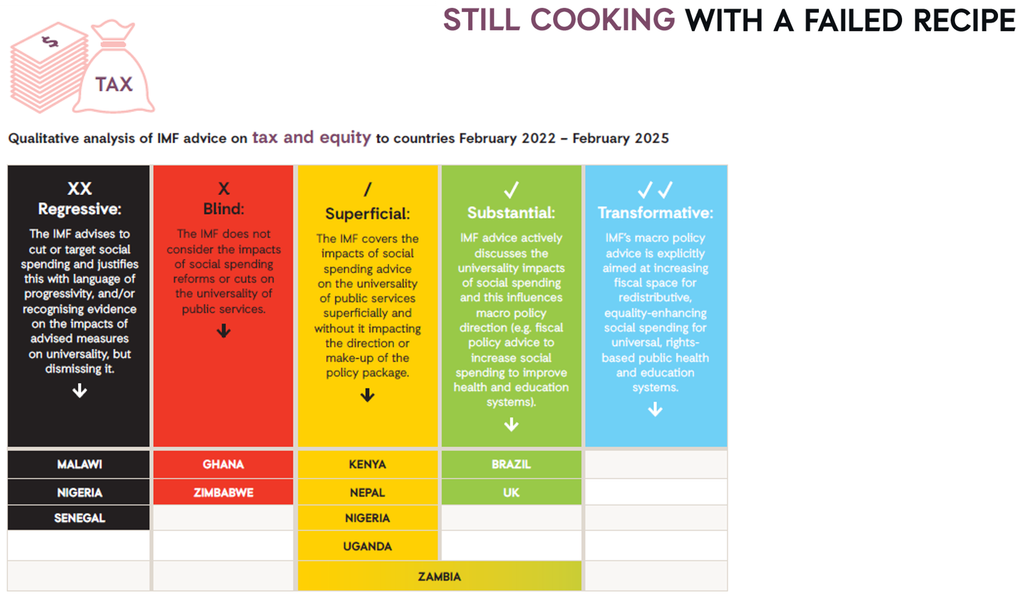
We found that the IMF is giving advice below its own thresholds — that is, tax-to-GDP ratios, which are extremely low to start with. This is linked to the Washington tax consensus that the IMF and the World Bank themselves implemented. More recently, in 2019 and 2023, the IMF’s Fiscal Affairs Department said that these ratios need to increase, but we found that the advice is not consistent with that.
There is no distributional analysis, with one exception — Brazil — and the period of this research ran until last year. We also did not see any analysis of the overall progressivity of the tax system, let alone of what progressivity means in terms of distributional impact. And we found that VAT still dominates, as Isabel mentioned, which is often highly regressive.
Brazil is the exception that proves the rule. In a Selected Issues paper, there was a distributional impact assessment of a VAT reform. Even so, the IMF concluded that the tax burden on the poorest decile would remain about twice as high as that on the richest decile, due to continued tax exemptions — for example on education and health expenditure — and this did not actually change the advice given. It does show that this kind of distributional impact analysis is possible, and we would like to see it for all tax policy advice, as well as for the overall tax system.
On gender equality, we did not see a lot. As you know, not long ago, three years ago in Marrakech, we were on a panel with the gender unit. But recently the US Treasury actually welcomed the IMF’s decision to consolidate the climate and gender units into its broader economic policy department and to remove certain issues from its programme. So it feels really pertinent that we are talking about gender equality — because of the extreme impacts of austerity on women and girls specifically, but also because of its absence from the discourse now.
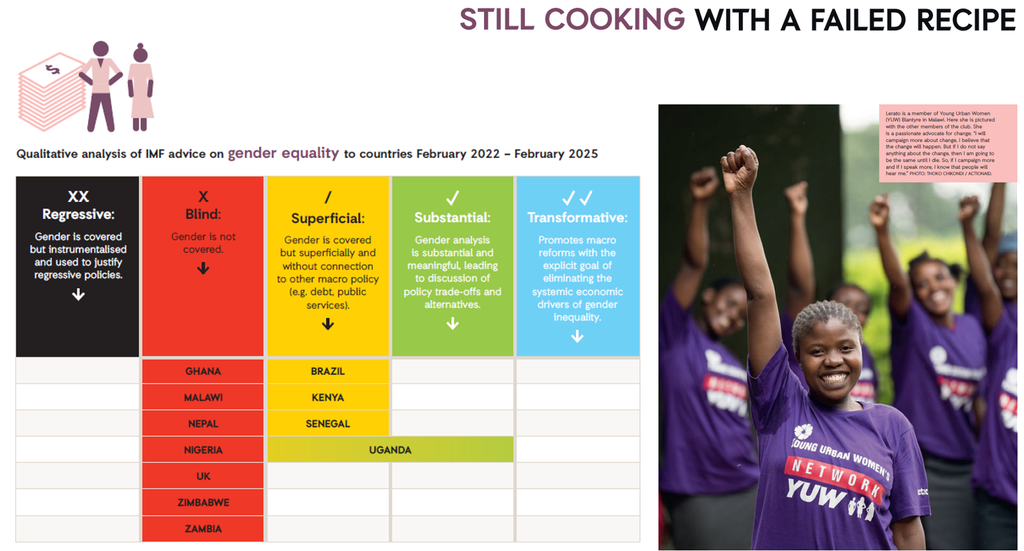
We did not find much gender analysis, and where there was some, it was highly tokenistic. It did not influence policy where it was mentioned in the text; gender was treated as an add-on rather than informing policy alternatives. There was no gender impact analysis of the IMF’s own bread-and-butter advice, which includes all fiscal policy. And where the IMF did speak of gender equality, it went into the territory of others, such as UN Women — talking about parental leave, childcare and pay gaps — instead of looking at its own fiscal policy advice.
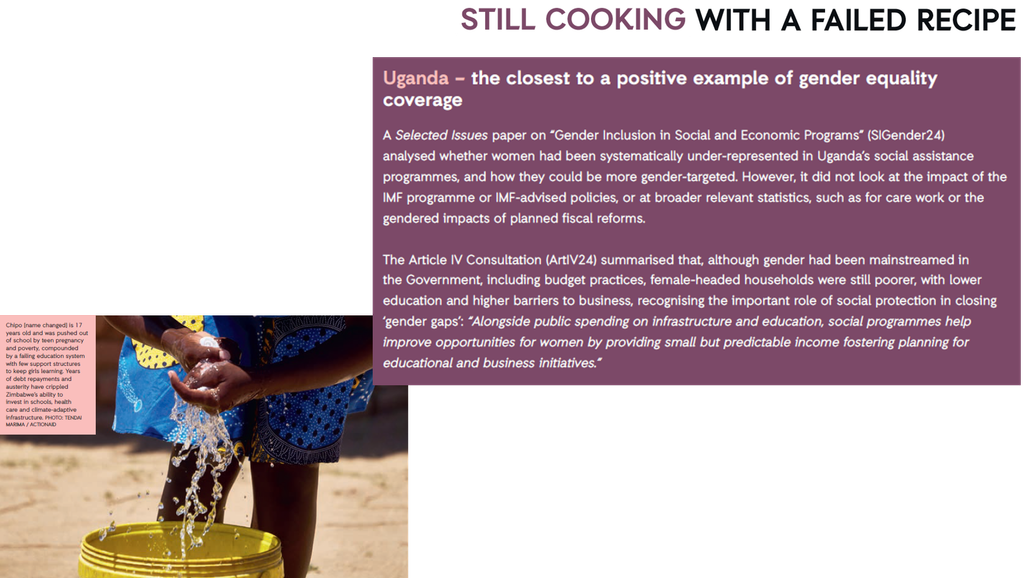
I’m trying to go through quite a big report, which quotes a lot of IMF text, so I recommend you look at it. The Uganda Selected Issues paper is the closest to a positive example on gender equality. It looks at what the Ugandan government does with social assistance programmes and how they could be more gender-targeted — and, as Isabel pointed out, targeting is not very progressive.
For all the countries we studied, we have summarized the IMF’s narrative in the text, and you will find it in a table in the report. On gender equality, the advice is largely gender-blind: Brazil, Kenya, Senegal and Uganda are the only countries with some sort of gender analysis.
On the public sector wage bill, there has been zero shift in the rhetoric, so it is still largely regressive, including calls for cuts to the public sector wage bill in order to prioritize social spending. That is highly contradictory, because the public sector wage bill is part of social spending — teachers and nurses, as Isabel pointed out.
I’ll skip over this part, but I wanted to show that the report also links, as Isabel did, to the power of protests and unions. The IMF noted that governments actually veered off austerity in their programmes — obviously without using the word “austerity” — in Nigeria, Senegal, the UK and Kenya. I’ll also skip the social spending advice, because I see I have three minutes left.
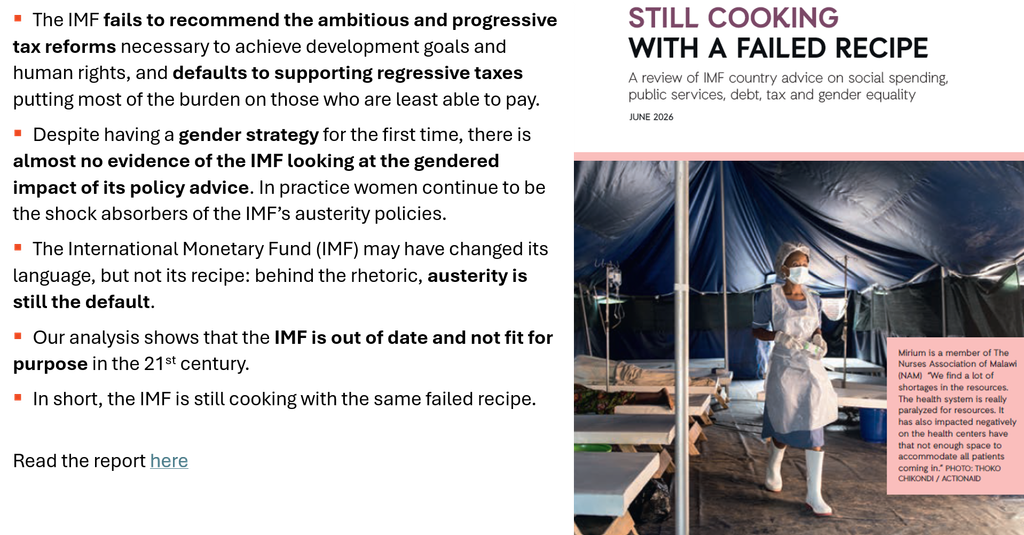
So, to summarize: we still find that the IMF presents a one-size-fits-all approach, especially if you look at the budget tables. The narrative has shifted somewhat on tax and on social spending, but not on the public sector wage bill, so the narrative coming out of Washington is not reflected in the advice given. The IMF also claims to focus on social protection, but opposes universal schemes, as Isabel pointed out, and the definitions used for social spending are highly inconsistent. Public sector wage bill cuts and freezes continue to be advised, undermining public service delivery as well as preparedness and resilience.
We find that the IMF still fails to recommend ambitious and progressive tax reforms to achieve development goals and human rights, and defaults to supporting regressive taxes, which put the burden on those least able to pay. And the current focus on tax revenues, without ensuring progressivity, assessing distributional impact, or providing debt cancellation or debt pauses in the current debt crisis, means that additional funds raised through tax go directly to repaying debt or to increasing defence spending, which is highly problematic. So, in essence, the narrative on tax has shifted, but its purpose is still really to repay debt and fund defence spending.
And despite the IMF having a gender strategy for the first time — while, as I just said, the gender unit has been disbanded — there is almost no evidence of the IMF looking at gendered impacts. Therefore, we continue to conclude that women are the shock absorbers of the IMF’s austerity policies.
ActionAid has also collected stories on the cost of austerity — the voices of those who paid the price — as part of our Young Urban Women Programme, and I highly recommend you check our social media to see them. We could spend a whole day or a week talking about those impacts, but I wanted to highlight their importance, because they are largely missing from the IMF’s analysis.
We are seeing a regression of women’s rights in real time; we are seeing a regression in gender equality. Last year, ActionAid’s report on the human cost of public sector cuts found that, in the six countries surveyed, cuts to public services directly linked to IMF programmes increased women’s unpaid care work by 20 hours per week, on top of what they already do. This is not captured in statistics, because GDP does not count unpaid care work. So we are seeing a real regression of women’s rights and a change in the discourse: gender equality is not mentioned anywhere; we are not supposed to talk about it. Yet women remain the shock absorbers of austerity.
So I just want to say that if we do not speak out on this, we are part of the silence. We are complicit in this gender regression. Economic policy and economic structures are not designed to look out for women’s rights, gender equality, the marginalized, or other intersecting discriminations. In crisis situations and recurring shocks — such as we are experiencing with increasing war, instability and the climate crisis — women are always the last to be considered and are often not at the table. We have seen in countries at war that women who used to be policy advisors to the government are now told to look after the family, to look after the nation. So it is really, really important to be aware that the excuse of urgency, the excuse of crisis, is never good enough not to talk about women’s rights and about the most marginalized and impacted.
Patricia Miranda: Thank you so much, Roos. It is very interesting how, after the data we saw with Isabel, we can now also see the qualitative information — how it is reflected on the ground — and austerity is still the rule.
I would now like to invite Chiara Mariotti, Human Rights Officer at the UN Office of the High Commissioner for Human Rights. OHCHR has just held a call for inputs on the impact of international financial institutions’ conditionalities on human rights, and several organizations here submitted inputs. Can you share with us the early findings of this initiative?
Chiara Mariotti (OHCHR): Thank you, Patricia, and thanks everyone for being here. Thanks also for mentioning this report. And, perhaps for Rodrigo’s sake: we are in touch with Robert Powell, who knows about this piece, and we have actually asked the IMF for a submission — hopefully a written one.
I must admit I made a bit of a mistake when I indicated what my presentation would be about today, because we are still going through all the findings and submissions. The report will come out in February or March, so I hope I won’t let you down too much by saying that the results will come in the spring. But I have a few other points that are relevant to this conversation and that will hopefully enrich it.
I also want colleagues here to be aware that OHCHR, the UN Human Rights Office, has in recent years stepped up its work on debt and on reform of the international financial architecture, and more generally its efforts to show the relevance of human rights for economic policymaking at national and international level. This is very much in line with what so many CSOs in the economic justice ecosystem are already doing. The human rights framework brings a normative framing to all of it — and that is actually one of the points I want to make.
I have organized this presentation in five simple points.
The first is that austerity — fiscal tightening — is a human rights issue. This is, of course, because public spending is crucial to finance the goods and services needed to realize human rights. But it is also — and this is a message to the IMF — because under international human rights law, states have an obligation to use what in human rights jargon is called the “maximum available resources” to progressively realize the human rights of their people. I make this point because I found it a bit troubling, earlier this week, to hear points made by the Managing Director — and not only her — stressing that countries are hesitant to cut public expenditure because of political considerations, because of the electoral cycle. That is certainly part of the story, but pretty much every country in the world is facing crises at different levels: cost of living, energy, climate. We cannot start from the premise that the reason countries are not cutting spending is that they fear not being re-elected. It is because they have a duty to spend in order to meet needs and fulfil the human rights of their citizens.
This brings me to my second point: human rights are not only an abstract concept — a nice abstract concept — but can also be a tool, both from a normative and from a practical point of view. Let me take the normative side first, because it links to what I was just saying. This is a moment of what people now call polycrisis, in which, frankly, the international community needs a moral compass to understand where it is going. International institutions need a moral compass, because they seem to be losing a little of their ability to admit that some things are right and some things are wrong. Human rights are a framework that has been adopted universally, precisely for times of crisis like this. So they are there to be used, to guide decision-making, especially difficult decision-making.
In terms of practical tools, human rights come with them. One is the concept of maximum available resources, which — I must admit, as an economist — I struggled to understand. But Isabel has explained it very well: it means that every government needs to look at all the different options available to achieve sustainability, keeping in mind that it also has obligations other than those towards its treasury. The other key tool is impact assessment. We call it human rights impact assessment; it doesn’t need to be called that, but the point is that we can do more of it. Of course, it does not solve all problems, but surely, in the era of AI, we can start endowing economic policymaking and advice with stronger tools that tell us about the consequences, ideally with more disaggregation.
My third point is that one of the objections we hear all the time to human rights being taken a bit more seriously by international financial institutions, including the IMF, is that they are too political, and that IFIs need to stay at arm’s length from political choices. The thing is that IFIs — not only the IMF, of course — are making political choices all the time, to the point that their governance frameworks have provisions for that, including, for instance, on how the IMF should engage with countries governed by authoritarian regimes. It has guidelines on how to navigate such situations. So it seems only natural that this could become possible for human rights too.
To give a very concrete example of what this might imply in practice: social spending floors, which have already been mentioned. It is good that they are part of the toolkit the IMF uses in conditionality, but their levels are deliberately not set: there is no standard that the IMF brings to a country. There may be good reasons for this, but it also means there is no guarantee that what is implemented as a social spending floor actually delivers what it is supposed to. If there are internationally recognized targets for macroeconomic variables — think of inflation, deficit levels or debt levels — perhaps it is time to have them for social spending levels too.
That brings me to my fourth point — I’m coming to the end. How am I doing with time, Patricia? Two minutes, okay. There is no need for the IMF to become a human rights expert; I don’t think anyone is asking for or wants that. As someone who works at the UN, my message is that there is so much expertise at country level that the IMF can rely on — not only my office. I know this already happens in many instances. I understand it is not easy, but when it comes to issues like this, there are alternatives to simply saying, “We don’t have the resources, we don’t have the expertise.” That may be true, but there are so many others working on the ground.
My final point goes a step further: I want to bring up the issue of “Beyond GDP” — friends here know this is my new obsession. The reason fiscal tightening is considered so necessary, and so strongly recommended by the IMF, has to do with the relationship between growth and debt levels. If we start rethinking how growth and economic progress are assessed, and take into consideration a wider variety of indicators of progress and development, that may also help us rethink how development finance, and finance in general, works — and how it continues to push countries into debt. I’ll stop here.
Patricia Miranda: Thank you. Indeed, although fiscal consolidation may not seem to be connected with human rights, austerity measures are a human rights issue, and the effort to mainstream this across every programme is very important.
Now I would like to turn to Farah Al-Shami, from the Arab Reform Initiative. Perhaps there could be light at the end of the tunnel? Would you share with us the alternatives that come out of the Finance for All project? What can be done?
Farah Al-Shami (Arab Reform Initiative): Thank you very much, Patricia. Unfortunately, covering the Arab region, I don’t really have a light at the end of the tunnel to present. But there are alternatives — they do exist — and I am going to draw on them. Thank you first, Isabel, for inviting us.
The title of this session asks a deceptively simple question: whose buffers? We keep coming back to it. On paper, rebuilding fiscal buffers sounds prudent; it sounds technical. It signals fiscal resilience, especially in the Arab region, which is battered by compounding price shocks, climate stress and — as we painfully see now — the devastating human and economic fallout of war and the subsequent rise in military expenditure.
But when we look at how rebuilding buffers is actually operationalized on the ground in the Arab region, a stark political economy reality emerges. Fiscal buffers are not being rebuilt by taxing accumulated wealth, oligopolistic corporate windfalls or financial elites. Instead, states are building their macroeconomic buffers by draining the buffers of ordinary households. Households are the buffers.
This is what we demonstrate through our evidence at the Arab Reform Initiative, through the Finance for All project — and many colleagues who belong to this project are here in the room. We combined macroeconomic and political economy analysis with original field surveys. The survey is not nationally representative, but it covers about 3,000 observations from the working-age and vulnerable population across Lebanon, Jordan, Tunisia and Morocco, alongside research in Egypt. We didn’t just look at budget lines: we asked households how fiscal adjustment, tax policy and IFI-backed social protection reforms actually play out in their everyday lives.
Our central finding was very clear: the social protection deficit in our region is not a resource scarcity problem. It is a political choice — a deliberate political choice. And the standard policy package promoted by the international financial institutions, which pairs fiscal consolidation and regressive taxation with narrowly targeted, proxy-means-tested cash transfers, is not protecting societies from adjustment but institutionalizing precarity.
Let me begin with the macro-fiscal squeeze, the main component of the story. We are repeatedly told by ministers and by the IMF that universal social protection is not affordable — that we don’t have the resources to fund it. Our evidence shows that what is truly unaffordable is the current distribution of the fiscal burden. Who is bearing that burden?
In Lebanon, for example, at the height of one of the worst financial collapses in modern history, the government actually ran primary budget surpluses, slashing public spending to signal fiscal discipline to the IMF at the exact moment citizens needed a lifeline. Even more perniciously, the fiscal adjustment was delivered covertly. Rather than legislating austerity in parliament, where at least civil society could contest it, the authorities allowed the currency to collapse by over 90%. This wiped out public sector wages and the reserves of the National Social Security Fund, while shielding the banking lobby from restructuring losses. I want to dwell a bit more on Lebanon, because today 82% of Lebanon’s revenue comes from taxes, nearly half of it from regressive VAT, while income and corporate taxes contribute a mere 11%. In our survey in Lebanon, 71.6% of workers reported direct harm from higher regressive taxes and fees.
Now, if we go to Jordan — and one of our authors, Mr. Ahmad Awad, is here — the country completed in June 2026 its fifth review under its tenth IMF arrangement since 1989. Sales taxes make up a staggering 68.1% of total tax revenue. In our field survey, 72% of respondents — including 72.5% of people with no work income at all — reported being hit by new or increased taxes and fees.
In Tunisia, external debt service has climbed to 9.9% of GDP. Caught between rigid debt payments and recurrent spending, the 2025 budget achieved consolidation by crushing public investment down to 2.4% of GDP, its lowest level on record. Rights remain intact on paper, but the hospitals, schools and local offices needed to exercise those rights are starved of resources.
Morocco has undertaken an ambitious expansion of social spending, from 9.2% to 11.2% of GDP, but debt interest payments have reached 2.8% of GDP, now exceeding public spending on health care, while regressive VAT remains the number one revenue source.
Now, why are targeted safety nets and social spending floors failing? When civil society raises these regressive impacts, the standard response from the IMF and the World Bank is to point to social spending floors and to the rollout of unified registries and poverty-targeted cash transfers. I won’t give you examples — there are so many in the region. Our cross-country empirical data reveal three fatal flaws in this model.
The first flaw is that expanding digital registries and targeted cash transfers does not equal effective protection, especially when inflation and public service cuts are eating away at the benefit. Morocco, for example, is often held up as the regional success story — “Morocco is doing better than other countries”, we hear — backed by over 720 million dollars in direct World Bank financing since 2020 to build its targeting architecture. In our survey of 900 vulnerable citizens in Morocco, the horizontal reach is real: 68.2% are covered by the AMO health insurance and 61% receive direct cash assistance. However, not a single one — 0% — of the 753 beneficiaries judged their protection to be sufficient or adequate. Why? Because the transfer values amount to roughly 15 to 22% of the minimum wage, at a time when food prices are jumping significantly and energy subsidies are being withdrawn.
In Tunisia, formal coverage has been hollowed out by austerity. We found that 60.9% of insured workers received zero or minimal reimbursement during their last health episode, and 31.5% of insured citizens had to forgo medical care altogether. Households exposed to budget cuts are 8.5 times more likely to suffer surging out-of-pocket health expenses. The same is true of Lebanon, where out-of-pocket health spending has reached 85% — one of the highest rates in the world, not just in the region.
The second flaw is that contributory systems are tied to formal wage labour, so they exclude the structural majority — and the labour market deregulation and flexibilization that the IMF promotes is making this worse. Across our samples, in all five contexts, between 42% and 69% of the working-age population are outside formal salaried employment. In Tunisia, a formal worker is 26 times more likely to have social coverage than an informal worker, and 33.5% of uncovered workers don’t even know whether their employer declares them; only 5% were offered formal declaration. Meanwhile, in Jordan, the IMF’s June 2026 review sets a structural benchmark for labour law amendments to streamline redundancies for firms. Yet our survey in Jordan shows that employment transitions are exactly the moment when protection collapses: 27% of workers who experienced a job change or job loss saw a decline in their social protection, and 38.6% of beneficiaries say benefits are too unpredictable to rely on.
Did you say one minute? I’ll try to wrap up. There is a third flaw I wanted to mention: proxy means testing, which depoliticizes redistribution and entrenches gender and legal exclusion. I will skip the gender component, although it is very important, because Roos has really covered it. But before I go to the recommendations, I want to say that reducing social justice to an algorithmic scoring formula — which 50% of Moroccan respondents say limits their access, and which penalizes rural families for sharing electricity meters and water wells — has removed social policy from democratic debate. In Morocco, 0% of respondents — again, 0% — recognized international donors as the main source of financing, which leaves citizens unable to scrutinize IMF conditionalities. Also in Morocco, 45.1% of allocations go to husbands, and this is decreasing family welfare.
So, who is the buffer? Obviously, families, women’s unpaid care work and household debt are the buffer. The most vulnerable are the buffers. When the state retreats, risk does not disappear; it is privatized. Across the board, we found that 30 to 64% of the surveyed population are borrowing, selling assets and decapitalizing as a coping mechanism in response to the status quo.
When we asked citizens what they want, they did not ask for better poverty-targeting algorithms. In Lebanon, for example, 58.6% demanded — verbatim — universal social protection, irrespective of work status: non-employment-based social protection. In Tunisia, 60% of informal workers want to join the contributory system if contributions are flexible and affordable.
So, if I just enumerate the recommendations — because, as always, I went past my one minute — to create a buffer for the people, and not just for public finances or the balance of payments:
First, we need to move from indicative social spending floors to effective social protection guarantees, and I can explain how in the Q&A.
Second, we need to shift fiscal consolidation away from consumption taxes towards progressive taxation of wealth, windfall profits and capital. There are also studies that estimate the revenues that could be generated from various forms of taxes, versus the cost of universal schemes that could be progressively introduced to ensure that universal social security is built.
Third, we need to support contributory inclusion and employer enforcement, not labour deregulation, flexibilization and liberalization.
And finally, we need to end poverty targeting, and link debt relief — or at least consider debt relief to begin with, and link or earmark it — to investment in universal social protection.
I’m going to stop here. Thank you for giving me more time. [Applause] And by the way, this study has many co-authors — I am not the sole author; one of them is here with me.
Patricia Miranda: Thank you so much, Farah. Indeed, whose buffers is a political choice, and we have heard about alternatives and how fiscal policy can make different choices.
I would now like to move to Rodrigo Valdés. Rodrigo, after these very powerful presentations — all by women, may I say — what are your reactions to this quantitative and qualitative evidence, and to the alternatives and proposals put forward, while keeping in mind the image of who these people are? Whose buffers? What are the faces of the people suffering these impacts in developing countries, in the Global South?
Rodrigo Valdés (IMF): Let me first thank civil society. I think it is very, very important to exchange views. These conversations may take years and many, many rounds, but it is always useful to hear different views. The first step is to understand others’ positions and where they are coming from.
I will try to react to what I heard, but I heard many, many things, so it is almost impossible to give a structured response to each point. So I want to share some general views across the different topics. Some come from my IMF experience, but I was also Minister of Finance for a while, and I am a citizen, so I will also react from those points of view. Of course, I am an IMF official, so I have to be very careful about how I craft those opinions.
It is interesting: if you made a word cloud of what we heard, it would be interesting to see what was missing. “Scarcity” didn’t come up much. “Trade-off” didn’t come up much. “Sustainability” of the accounts didn’t come up much. Those are words I would put on the table as very important, and that I want you to take from my reactions.
I want to react in a technical sense to Isabel’s presentation, because she used a very powerful idea: that spending has been dropping. Imagine I went to your household and told you, “Oh, you are not increasing your spending every year.” In fact, countries are going up and down more or less half of the time — there are about 200 countries in there. That’s normal: some years spending goes up, some years it goes down. Then comes the issue of sustainability. It is not possible to spend more and more of GDP every year. That is not physically possible; it is not sustainable; it is a recipe for problems down the road. It’s the same in a household. Everybody has some uncle or cousin who overspends, and someone has to intervene, take away the credit card, help them out with money. That is a problematic case. This idea of spending, spending, spending, and less and less saving, is not the right magic.
My next reaction: I understand perfectly well that we are living through very tough times, with many shocks together — I will come back to that later. But it is very important not to forget that the way we can react in bad times is ultimately decided not in bad times; by then it is too late, and debt is what it is. It is really decided in good times. A crisis is not the moment to design a full safety net. That is a social contract you build when you have the space to deal with long-term issues. When a country is fighting for stability — so that the exchange rate doesn’t go through the roof, so that inflation doesn’t take off — that is not the moment; the other moment is when you can focus on structural issues. So my point — and I’m sorry, I won’t be able to keep track of the number of things I’m saying — is that it is very important to use good times appropriately. That is when you build buffers, not when you need them. Unfortunately, for different reasons, countries are not very good at that.
The next topic is targeting. First, I want to recognize that fuel and food are two very, very different topics. When you have a food shock, it is very difficult, and — by the way — about three weeks ago we put out a blog and a paper on how to deal with food shocks. The origin of the shock matters a lot for how you deal with a food price or food availability shock, and we recognize that. That is a completely different topic from fuel.
So let me move to fuel. Fuel subsidies today cost the world economy 0.5% of GDP, and they are largely regressive. Why should a rich person with a modern car pay a subsidized gasoline price? If you can use the same money more efficiently, aren’t you better off?
The next point comes from my own experience — nothing to do with the IMF’s work — as minister. Probably one of the most difficult series of meetings I had was with the public sector unions. Very, very difficult. And there was one number we put on the table that produced a lot of tension: the bigger the wage adjustment, the worse the impact on the country’s Gini coefficient. Public sector workers — and I was one, and as an international official I am one now — are actually in the upper part of the income distribution. In fact, if you look at how many people resign from government to go to the private sector because they have a better opportunity, it is very few; the line of people trying to get from the private sector into the public sector is very long. So the bottom line in the discussion on targeting is that we need to be very careful with numbers. The fact that someone protests — and of course protest is a right — does not mean that what is behind the protest is the common good.
Let me move to something very difficult: the size of government. Here we need to recognize that economics is not enough to pin down how high taxes should be or how much you should spend. Some societies decide to have bigger governments, some smaller. At least from the IMF’s perspective, we are very respectful of what each society decides. It is not our job to decide the size of government in a country. But we can advise, and in a programme we can negotiate, that revenues and spending have to more or less match; otherwise it is not sustainable. That is not an idea you can dismiss as liberal or anything else. It is like a law: if you spend more than you have, as in your house, debt accumulates. That is unavoidable. And that is where we come in and help countries, saying: look, this will happen; you don’t want to get into that trouble; do this, or these other things — there are alternatives.
But it is very important to recognize that this challenge is becoming more difficult, because unfortunately interest rates in the world economy have been going up over the last few years, and you have seen how they went up for the developed world in the last few months. That completely changes the equation. Again, think of your family: imagine you have some debt, and interest rates start to rise when you have to roll over that debt. That is the reality today. So the bad news at these Annual Meetings is that the fiscal situation is more challenging than six months ago — for everybody, even for advanced countries.
In some of the presentations I heard something that is important, but I want to try to convince you that it is a very partial view. Let me simplify it: “VAT is regressive, so we shouldn’t use it.” In general, it is very difficult to think of a society that has reached the level of social contract of, say, the Nordics — a very interesting arrangement, a true welfare state — where the welfare state is paid for by the 1%. That doesn’t exist in the examples we have of real welfare states: everybody contributes a lot. It is important to keep that in mind, because the idea I sometimes see, more in the developing world, that we can have a welfare state but have someone else pay for it may be appealing, but we don’t have examples of it.
Let me give you the following example. Take a society with one person who earns 1 per month and another who earns 100 per month, and the richer person saves a bit. The typical argument is that with a 10% VAT, the rich person will pay slightly less than 10% of their income, because they save a bit and their consumption is not 100, while the poor person pays the full 10% of what they receive. That’s true. However, the collection is close to 11: 0.1 from the poor person and almost 10 from the rich person. So everything now depends on what you do with those 11. Let’s say 10. If we manage — without even targeting — to split that 10, giving 5 to the poor person and 5 to the rich person, the income distribution in that society has changed completely.
Of course, you could tell me it would be better to levy a personal income tax on the richer person. Yes, I agree, with two caveats. One, it is very difficult to muster the political support for that. Second, there could be effects on how that person reacts — hours worked, where they live, and so on — that could leave you without the money in the end.
What I am trying to say is that you need a much more holistic view of the effects of the public finance system. If you ask each instrument to be good for everything — each tax to be good for growth, for income distribution, for labour force participation, for gender equity — there is no instrument that does all that. You need a collection of instruments and to evaluate all of them together. This is very important, because otherwise you don’t have the instruments to attain your objectives.
And since I am talking about instruments, it is very important to separate objectives from instruments in our discussions. We tend to combine the two too easily, and instruments start to take on a life of their own. It is important to respect preferences. Societies have preferences; many of you — not all of you — are advocates of a view, and that is a perfectly legitimate part of society. But how you design the instruments to get there is something we need to be more careful with. That is where technicalities become more complex. Of course, some people could abuse that and say, “No, this is a technicality”, and so on — I agree. But it is important to say: look, be careful with some of the instruments you propose.
Two more things I want to mention. One is the issue of debt and intergenerational equity. One way to think about the problem — how much debt, what to do with debt — is that, at the end of the day, if we leave more debt, future generations will pay. Sometimes I am a bit puzzled that one part of the political spectrum cares a lot, and with good reason, about the future of nature but doesn’t care much about debt, while the other side of the political spectrum cares a lot about debt and very little about nature. Both belong to our great-grandchildren, so we have to be mindful of that. I sometimes say that ministers of finance are the only representatives of future generations in the current discussion.
And my final point is about human rights, and how I, at least, have worked with this issue at the Fund. I am relatively new at the Fund — I worked there for a few years some time ago, and I have been here almost four years this time round. Before coming to Fiscal Affairs, I was in the Western Hemisphere Department, which deals with the Americas. There we had a very interesting engagement with civil society around this issue, because I really didn’t know how to deal with a couple of countries that were complex, from very different perspectives, ideologically speaking. So we had a good meeting with civil society to ask what they thought. My prior was that they would tell us not to engage. It was the opposite — that was my first surprise: “Go, you have to talk to the authorities, because very few people are talking to them.” The second thing was: “Okay, but I cannot take on your agenda; it is outside my mandate. I may have my personal views, but the IMF has to stay in its lane.” And they were perfectly okay with that.
The arrangement is such that we have a mandate, and we work within that mandate. Time is almost over — let me just finish, because the point I want to make is very simple. At the end of the day, we can make progress on certain issues that border that agenda. For example, the governance of public finances is something we take very seriously at the Fund; our department and the Legal Department work together on it, and that has implications for transparency, which is useful. But again, we cannot trespass on lines that are the job of others. Thank you very much. Very interesting — I wish we had more time.
Patricia Miranda: Thank you, Rodrigo. It was indeed a challenge to take in all the inputs from this panel and react to all of them in ten minutes. I will now open the floor for questions and comments. We have 17 minutes left, so I believe we can have one round of questions and then ask the panel to reply or give their final remarks.
Nabil Abdo (Oxfam International): I have a question for Mr. Valdés. The Review of Conditionality and the Comprehensive Surveillance Review have been concluded, with the Board deciding on the need for distributional impact assessment, or for the Fund to be cognizant of the distributional impact of its policies and advice. So my question is: as head of FAD, how will you implement this outcome of the reviews? Will we see more public distributional impact assessments in Article IV reports and programme documents?
Pradeep Baisakh (GCAP): I am the Asia coordinator of GCAP, the Global Call to Action against Poverty. I am bringing the voice of many people from a people’s assembly we held with the most marginalized groups we work with. They have come with this suggestion to the IMF: you keep talking about your mandate — please change that mandate to serve the interests of the poor, not of the rich countries. That’s the impression they have. So we request you to overhaul the whole international financial architecture, including debt and interest rates. It cannot be that Germany borrows at a 0.5% interest rate while an African country borrows at 10%, as decided by credit rating agencies based in the US and the UK. In our understanding, the whole system has been hijacked by the rich countries and their people. Kindly change the system so that it actually serves the marginalized groups whose income is 1, not 100.
Joanne Jorrogué (ActionAid International, Kenya): Picking up on your final remarks on transparency and governance — you said you push for transparency in governance. My question is: why is there no transparency in your agreements at national level? We have heard from the presenters that the public has the right to information, and yet citizens are expected to pay back these loans. Why do you leave it to governments’ discretion to be transparent, while saying you push for transparency in governance?
Thomo Abunu (Monrovia, Liberia)
Unlike income tax, value added taxes have the same rate regardless of a person’s income, so they can become a heavier burden on lower-income households. How can governments best design the system — for example, by exempting essential goods and services, or through targeted transfers — so that revenue mobilization does not deepen poverty among low-income people? Thank you.
Unidentified participant
I fear I might leave this room without an answer to the question “Whose buffers?” Our representative from the IMF is speaking as if, when it’s good, it’s good for all of us, and when it’s bad, it’s bad for all of us. But the focus is on whose buffers — who is actually absorbing the shocks. Our panellists spoke about women, and about the fact that the gender department has been taken away. What is the IMF saying about that? About African countries, lower-income countries in debt distress, where debt is undermining public spending — which means no more nurses, no more teachers? Those are the shock absorbers. What is the IMF saying about those people? So let’s not generalize, as if it were only a matter of planning in good times: we are not all experiencing these things in the same way. It is important to talk about those shock absorbers and what we are doing in policy to resolve their problems. We want to go home knowing what the IMF’s policy is for addressing the shocks that poor people, women, Africa and the Global South are absorbing. Thanks.
Ralph Dugan (Reality of Aid – Asia Pacific): I’m Ralph Dugan, from Reality of Aid – Asia Pacific and the End Austerity Campaign. A very short reaction before my question: you said we should focus on social safety nets in good economic times and not during a crisis. But the truth is that we are in a crisis, and it is the result of the perpetual indebtedness countries are experiencing due to conditionalities imposed by the IMF over the years. My question — and I’m not entirely sure whether this is within the IMF’s mandate — is: what is your perspective on civil society’s recommendation that countries decrease their military spending so that they have more budget for social protection? Thank you.
Patricia Miranda: Rodrigo, we have received six questions. Please go ahead.
Rodrigo Valdés: First let me recognize the complexity here. If I had the solution, I would be very famous. The challenge the world faces is very difficult, that’s very clear: we have several shocks coming one after another. But there have been cases of countries that were faster than others and in a better position, so I don’t want to let this go so easily. Some countries, for example, increased their deficits a lot after COVID, but they managed to bring them back. So again, it is the years when you are not suffering a big crisis that you use to prepare for the other years. And those buffers are certainly for the people. I agree completely with the broader title of this gathering; it is very important not to lose sight of why we do this.
I will go in order now. Distributional assessment is already happening to a certain extent. For example, if you ask my team what the effect on income distribution of a fuel tax or a fuel subsidy is, they will be able to answer for many, many countries in the world. We have more and better data, and we have to keep building tools to evaluate this. By the way, this matters not only because anyone should care about income distribution, but also because it is critical to the political dynamics around policy decisions. One of the issues we understand more and more — not perfectly yet — is that political dynamics matter. I was recently moderating a panel with authorities and market participants, and I was very interested to hear from both the importance of going beyond economics. I summarized that round by saying that sociologists and political experts are very important to this discussion too. And the ministers were very clear: the cornerstone of their successful programmes was convincing people that this was important.
There was a question about the IMF’s mandate. That is well above my pay grade; that’s all I can say. What I would say, though, is that there are few institutions in the world economy today where the entire world gets together and discusses things honestly. At the Board, countries with very different views are present, and there is important, honest discussion. We have to take care of the few spaces in the world today where that happens, and I value that.
A very good question about transparency, loans and so on. Let me give you some ideas. First, the loans you have to repay today represent deficits of the past. That is why I keep going back to the past: debt is not always the solution, because it has to be repaid. Second, and this is very important, debt sometimes rises to a level that is too high and impossible to repay. That is why debt restructuring comes to the table, and it is an important discussion in some cases — and restructurings are happening. Senegal, for example, has just started a debt restructuring process, and we support those decisions when they are made. But two important footnotes. One: debt restructuring is not easy. Some people think it is a way of forgetting about paying the debt, but it is not a trivial way out: you lose market access, and sometimes you have problems with your financial system. That is why many countries — rather than the Fund — think that restructuring is not a good way out. Two: once you restructure, the parameters have to be very, very carefully calibrated, because you have already paid a big fixed cost by entering into it.
The question from West Africa about VAT was very important. Let me say the following. One solution is to exempt some goods from VAT. But usually — I would even say always — someone richer will be consuming more of that good, so you lose a lot of revenue. It is much better to have a system where you collect the revenue and give it back, perhaps through cash transfers to those who need them, using data, technology and so on. But very often it is also very important to ask governments to be efficient in providing the goods they should provide: schooling for those families, health care for those families. That part is a bit further from our day-to-day work at the Fund, because we are more on the macroeconomic side, but it is very central. If I had to say one thing I learned from my experience in government, it is that having an idea is one thing, and implementation is something very different. The quality of human resources and the capacity to do things are critical. One of the issues we need to pay more attention to is the quality of governments in delivering the services people need.
Patricia Miranda: Thank you, Rodrigo. We have just three minutes left, and I would like to give the floor to the rest of the panel for a last message. If that’s fine, I’ll start in reverse order, and ask for a very brief, 30-second final thought, comment or recommendation.
Farah Al-Shami: Thank you very much. Because I was a bit fixated on doing justice to the study and its numbers, I want to clarify the first recommendation I made: moving from indicative social spending floors to effective protection guarantees, especially since, over the last decade, social spending floors have decreased by 50% in value. What I mean is that we need to stop conditioning subsidy removal on narrow poverty-targeted programmes. Any subsidy reform — to give just one example — must be strictly subordinated to prior universal, inflation-indexed benefits. If we really want to protect people, benefits need to be in real terms and inflation-adjusted.
The gentleman over there mentioned resource mobilization. I think we also need to start shifting our thinking from resource mobilization to resource redistribution: wealth redistribution, public resource redistribution. Military spending was mentioned; debt servicing is also a big issue. From a previous study of ours, you can see that military spending competes with health and social protection spending in the region, and on the next slide, that we pay more on debt servicing than on health.
Chiara Mariotti: Many provocations, but one thing struck me: the point on intergenerational equity and debt. I am Italian, so, you know, I was raised being told that public debt was going to ruin my life — and it probably means I am not going to have a pension. More seriously: public debt is definitely not the only problem facing young people in Italy. Young Italians also suffer from the fact that the government stopped investing 20 years ago and has basically been doing austerity since the global financial crisis. This means that salaries are among the lowest in Europe and job opportunities are very scarce.
But beyond Italy — and I am not an expert — the point I wanted to make is that there are several factors to take into consideration when we think about intergenerational equity or intergenerational justice. Climate change, for instance: not investing in mitigation and adaptation is also going to have huge consequences. The point on trade-offs is right; there are huge trade-offs. But sometimes these institutions seem to forget that there is another side to the trade-off. And I think the call from everyone here is that it would be nice, sometimes, to hear a little about that other side as well. Thanks.
Roos Saalbrink: Very briefly, trying to pull together several different thoughts. Rodrigo mentioned “structural”, but in our analysis we see structural as something different. We look, for example, at the colonial legacies in the international financial architecture. Africa loses 90 billion dollars a year in illicit financial flows and remains a net contributor to the global economy, if you count overseas development aid — which we know has been shrinking — as well as foreign direct investment. That is obviously the world upside down.
When we think about redistribution, and why it is so easy to impose austerity but so hard to impose wealth taxes, that is obviously a question of power: the powerful are much better at protecting their interests, and at capturing institutions to do so.
On the overall progressivity or distributional analysis of tax: please publish it, so that we can see it and look at it. We really looked for it. Have a look at this report — there is a lot on tax in it — and there are cards here with a QR code you can scan.
And lastly, we clearly did not have enough time to share even the overwhelming evidence we have. So we really hope there will be better, continuous CSO engagement at national level, as the Managing Director promised us on Monday. Thank you.
Isabel Ortiz: It is an honour to have you here, Rodrigo. We ask you to please listen to the arguments presented today. I don’t envy your job. Many people here don’t know that you were Minister of Finance under Michelle Bachelet. You had difficult times then, but now they are much more difficult.
You mentioned three key issues: scarcity, sustainability and trade-offs. But look: inequality has never been higher in history. We live in a world awash with money. So sustainability and buffers cannot be demanded of the middle and working classes; we are squeezing them. The IMF needs to start looking up — to see where the resources of this world, awash with money, are, where all these inequalities are, to the wealthy and corporations — and then start thinking about how to bring that money down for development, for the Sustainable Development Goals, and for human rights. Please listen. Thank you.
Rodrigo Valdés:Let me just thank Isabel for organizing this. I knew it would be challenging; we sometimes come from very different perspectives — I’m a macroeconomist, I think as an economist. But it is super important to have spaces like this one where we can hear each other. It is the only way to make progress. Thank you.