
“Britain is experiencing a sustained decline in healthy life expectancy and widening inequalities between places and social groups” and this is the result of “the detrimental effect of austerity”, concludes Martin McKee, past president of the British Medical Association (BMA) and strategic adviser to the European Public Health Association (EUPHA).
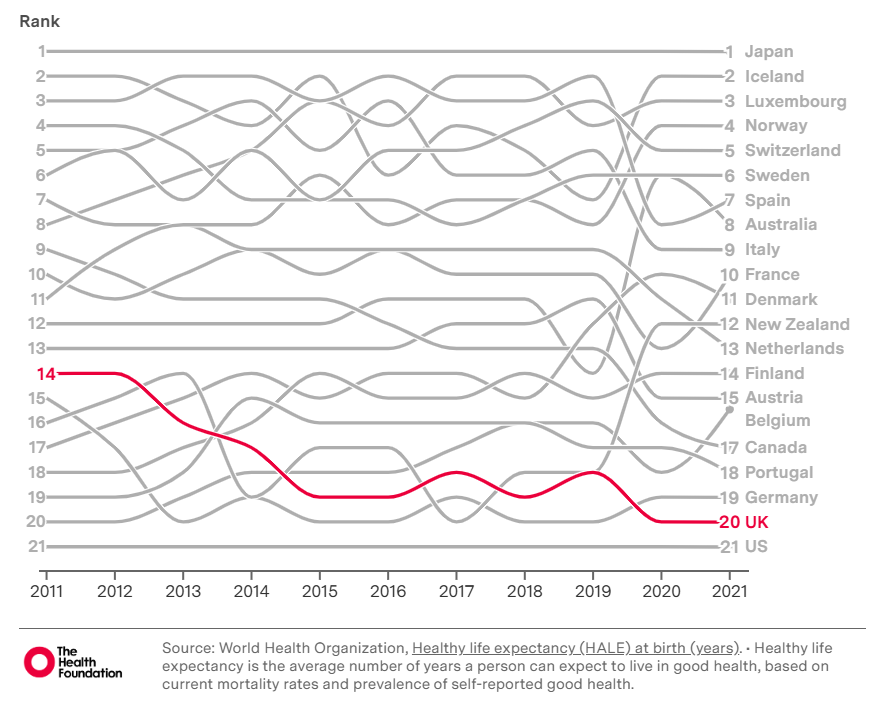
In a study co-authored with health researcher Lucinda Hiam and published by the prestigious TheBMJ (Bristish Medical Journal) in its May edition, they point out that “among comparable high income countries, only the US has lower healthy life expectancy than the UK”.
This deterioration in Britain’s health “coincides closely with the introduction of austerity policies in the early 2010s. Across multiple indicators, the inflexion point in healthy life expectancy, mortality trends, and geographical inequalities coincides with the start of a decade of sustained reductions in public spending, particularly affecting local government, welfare, and public services. Despite this, austerity is notably absent from many major reports and most of the recent media coverage”.
An ageing population, unhealthy individual behaviours, flu seasons, NHS pressures, and, more recently, the long shadow of the covid-19 pandemic are all true factors, “but none fully explain the timing, scale, or unequal distribution of decline in healthy life expectancy. Together, they are a repertoire of accepted stories rather than comprehensive explanations.”
The study argues that “there is now extensive evidence that austerity provides a coherent framework to explain declining healthy life expectancy. It accounts for the timing of the decline, explains why some places have deteriorated more than others, and aligns with substantial evidence on the social determinants of health and the increasingly precarious conditions faced by many communities.”
Nevertheless, speaking about austerity and health is difficult. “Firstly, naming austerity assigns responsibility to specific fiscal decisions and the governments that enacted them. For organisations positioned as analytically neutral, such attribution can carry reputational and political costs.”
Secondly, “structural explanations that implicate policy are often required to meet exceptionally high thresholds of proof. By contrast, proximate explanations such as ageing, behaviour, or system pressures are accepted with comparatively little scrutiny.”
Thirdly, the media prioritises immediate and simple explanations. “The cumulative effects of austerity, unfolding unevenly over time and place, are harder to narrate than discrete shocks or individual behaviours. Lacking a single dramatic moment, austerity struggles to register as newsworthy, even when its consequences are profound”.
Finally, “silence is sustained by moral comfort. Behavioural narratives assign responsibility to individuals, whereas structural explanations challenge assumptions about inequality and fairness. In doing so, they unsettle dominant moral frameworks”.
The authors conclude that “the narrative must shift to explaining why health is deteriorating, situating health within wider debates on fiscal policy, welfare, and public investment. Naming austerity as a key factor in the UK’s worsening health is a precondition for meaningful change”.