by Roberto Bissio
Austerity is a virtue that all civilizations have praised.
Talking about one of his disciples, Confucius wrote: “”Admirable indeed was the virtue of Hui! With a single bamboo dish of rice, a single gourd dish of drink, and living in his mean narrow lane, while others could not have endured the distress, Hui did not allow his joy to be affected by it.” (Analects, Book VI, Chapter 11).
Jesus said that “it is hard for someone who is rich to enter the kingdom of heaven” (Mathew 19:23) and the Prophet Muhammad similarly taught that “wealth is not in having many possessions, but rather true wealth is the richness of the soul.” (Hadith 6446).
In classic Athens, the opposite of austerity was hybris (often translated as arrogant excess), which was a crime worse than assault when for personal gain or contempt someone humiliated or dishonoured a victim.
In my country, Uruguay, both his followers and those who opposed him respected the late president José Mujica for his austerity. He donated 90% of his salary to charities, lived with his wife (herself a senator) in what the BBC described as “a ramshackle farm” without domestic service with “laundry strung outside the house, water from a well in a yard, overgrown with weeds and only two police officers and Manuela, a three-legged dog, keeping watch outside”.
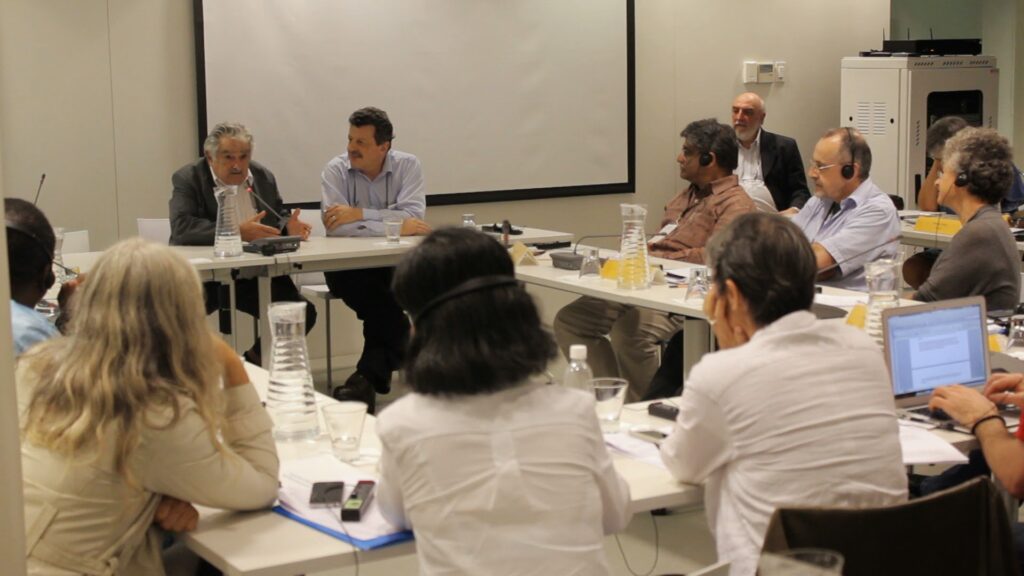
José Mujica with the author and a group of international civil society campaigners during a Social Watch strategy meeting in Montevideo, 2014
When he was called “the poorest president in the world” he argued despising “those who only work to try to keep an expensive lifestyle and always want more and more.”
“This is a matter of freedom. If you don’t have many possessions then you don’t need to work all your life like a slave to sustain them, and therefore you have more time for yourself,” he says.
He was obviously inspired by the stoic philosopher Seneca: “The greatest wealth is a poverty of desires” (Epistulae Morales).
The Malaysian environmentalist Mohd Idris, and the organization he founded, Sahabat Alam Malaysia (Friends of the Earth-Malysia) were granted the Right Livelihood Award in 1988, together with the indigenous Penan people that were struggling to defend the forests of Sarawak. In his acceptance speech at the Swedish Parliament Martin Khor, then director of the Third World Network, updated that message: “Live simply so that everyone on this earth can simply live.”
At that same moment in the famous film “Wall Street”, Gordon Gekko (acted by Michael Douglas) was enunciating and popularizing the new mantra of neoliberalism: “Greed is good!”
Privatization and deregulation spread like wildfire across the world and the World Bank and the International Monetary Fund (IMF) imposed them to developing countries as a condition for their loans, under the motto of “structural adjustment”.
The structural adjustment policies destroyed public services, undermined workers’ rights and burdened women even more. They were resisted in the streets by trade unions, feminists, environmentalists and human rights defenders.
During a meeting at the OECD headquarters in Paris, I overheard a prominent economist of the World Bank admit that “actually we realized that Structural Adjustment has acquired negative connotations, so we decided… to change the name.” And the new name since then is “austerity policies”.
During the Covid pandemic the IMF advised all countries to spend more, to assist the people affected by Covid, but also to save the world from entering a global recession. But once the virus retreated, there was no assistance to developing countries to pay the bill and a wave of “austerity” took the whole world by assault like a tsunami.
By 2022, a report by Isabel Ortiz and Matthew Cummins demonstrated that “austerity measures” were affecting more than 80% of the global population. At the same time, in 2021 the annual Forbes list of the world’s billionaires, announced an increase of 660 more “members” than in 2020, raising the total to 2,755 billionaires with a total net wealth of $13.1 trillion. 86% of these billionaires had more wealth than they possessed the year before.
This is not the virtuous austerity that we all admire, but a perverse use of the word. And this is why the #EndAusterity Campaign was launched, to denounce the negative social impacts and to suggest alternatives.
Now, in April 2026 the governments of the world are pushed or tempted to initiate a new wave of “austerity policies”, with more belt tightening of the poor and middle classes to face the energy crisis resulting from the war in the Persian Gulf, instead of taxing the windfall profits of fossil fuel companies, for example. And that emerging threat is the reason for my joining enthusiastically this campaign as coordinator, convinced that #EndAusterity is necessary to replace these policies with the true austerity (that starts with the rich) and the justice that civilization and the planet need for its very survival.
| Austerity Policies | Alternatives |
| + Targeting and rationalizing social protection + Wage bill cuts/caps + Eliminating subsidies + Privatization/PPPs/Commercialization of Public Services + Pension and Social Security reforms + Waiving employers’ contributions to social security + Labor flexibilization reforms | + Increasing progressive tax revenues (wealth taxes, windfall profits,global tax reform, digital services…) + Restructuring/eliminating debt + Fighting illicit financial flows +Increasing social security financing by adequate employers’ contributions and formalizing workers +Re-allocating public expenditures |